

This Week’s Top 5 Market Movers: Israel - Iran Conflict, G7 Diplomacy, and Fed Policy Signals
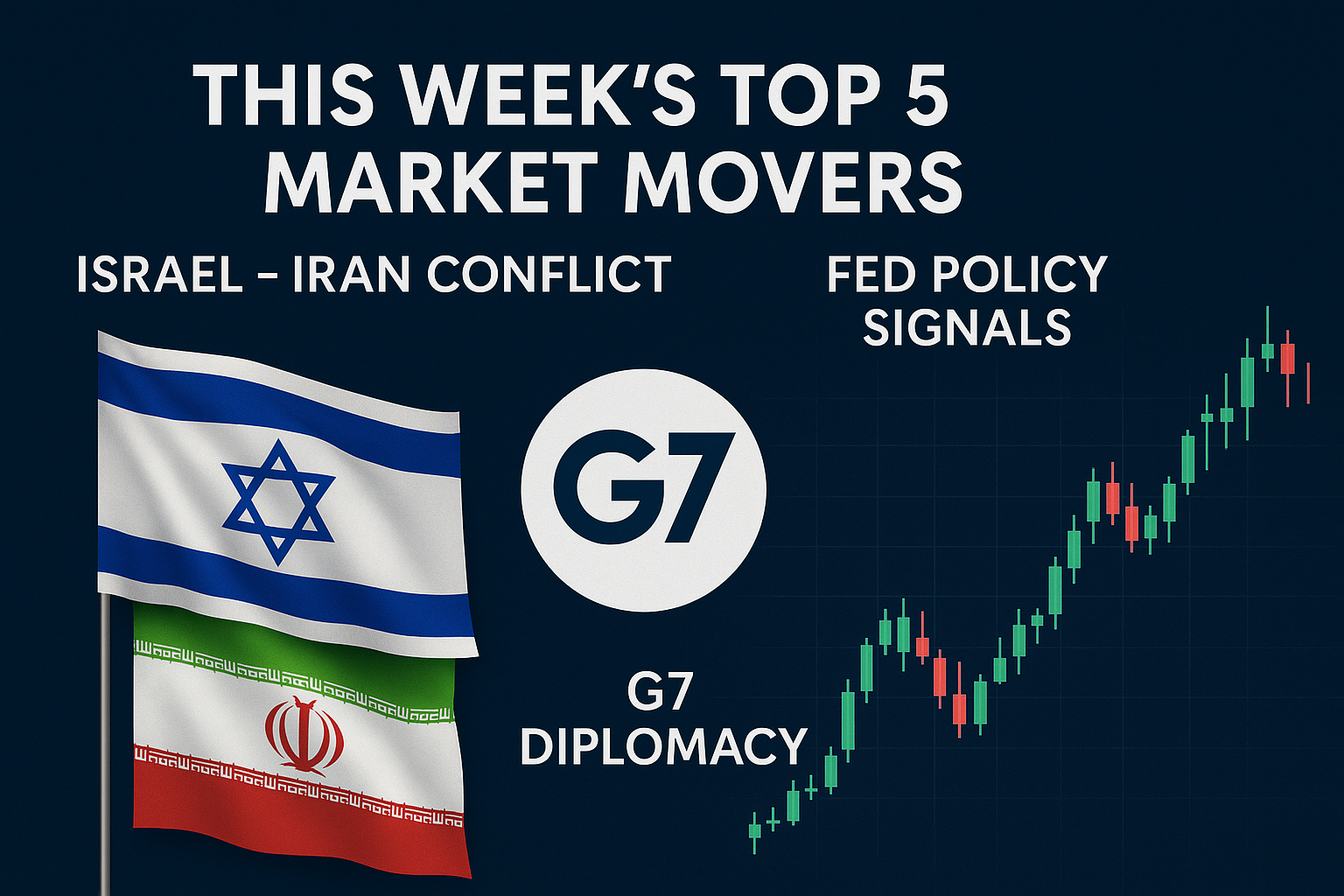
This Week’s Top 5 Market Movers: Israel - Iran Conflict, G7 Diplomacy, and Fed Policy Signals
News Article | June 17, 2025
Markets Kick Off the Week with Risk-Off Mood Amid Rising Global Uncertainty
Investors are navigating a tense landscape as geopolitical conflicts, trade friction, and crucial central bank decisions come to a head. Here are the five main developments commanding attention:
1. Israel-Iran Tensions Escalate, Driving Oil Prices Higher
Tensions in the Middle East deepened over the weekend with renewed clashes between Israel and Iran. Despite international diplomatic outreach, Tehran has dismissed the idea of a ceasefire, while Israeli airstrikes continue targeting Iranian nuclear and missile infrastructure.
As of early Tuesday, Brent crude edged up 0.4% to $74.53 and WTI rose 0.5% to $71.64, extending earlier gains of more than $4. The intensifying conflict is raising concerns of a broader regional war, with Israel urging evacuations near Iran's nuclear sites.
The market remains highly sensitive to energy supply disruptions, as climbing oil prices threaten to reignite global inflationary pressures.
2. G7 Summit Tackles Geopolitical Risks and Trade Strains
G7 leaders are gathering in Canada this week with a focus on two pressing issues: the escalating Israel-Iran crisis and ongoing trade disputes, particularly with the United States.
While a joint call for de-escalation is expected, unity may be fragile. German Chancellor Friedrich Merz has stressed a dual approach—backing Israel’s security while urging Iran to halt its nuclear activities.
Meanwhile, Canadian Prime Minister Mark Carney has warned of potential countermeasures if the U.S. maintains its tariffs on steel and aluminum. With President Trump's protectionist agenda continuing to shape global trade policy, investor confidence in international collaboration remains subdued.
3. Central Banks in the Spotlight, Led by the Fed
All eyes are on the Federal Reserve’s policy announcement on Wednesday. While the Fed is anticipated to keep rates steady at 4.25%-4.5%, investors are more focused on its outlook, especially as oil-driven inflationary pressures resurface.
The Fed faces a complex balancing act—moderate inflation, stable job numbers, and residual effects from trade tariffs are all factors in the mix.
Several other major central banks, including those in Switzerland, Sweden, the U.K., and Norway, will also issue decisions this week. Their actions could significantly influence global monetary policy sentiment amid escalating geopolitical uncertainties.
4. U.S. Retail Sales to Test Consumer Confidence
Amid trade headwinds, May’s U.S. retail sales report will offer a key gauge of consumer strength. Analysts expect a 0.6% monthly drop, following April’s slight 0.1% gain.
There is a silver lining: consumer sentiment improved in June, buoyed by hopes for a resolution in U.S.-China trade relations, according to University of Michigan data. However, rising fuel costs linked to global tensions could quickly dent that optimism and curb discretionary spending.
5. China’s Economy Shows Uneven Recovery
China’s latest economic data for May painted a mixed picture. Industrial production rose 5.8% year-over-year, falling short of expectations and down from 6.1% in April, largely due to softer export demand amid persistent U.S. tariffs.
On a brighter note, retail sales in China beat forecasts, fueled by holiday consumption and local promotions. This suggests some resilience in domestic demand even as external challenges persist.
RECENT POST
- The Nuclear Signal Nobody Is…
- What Did Our Quant Signals…
- QNST, BLMN, PGY & HURN:…
- Oil, Inflation and Yields Put…
- All Eyes on Today’s CPI…
- SpaceX IPO 2026: Expected Valuation,…
- New Record Highs for Markets…
- Year-End Markets in Focus: A…
- Wall Street Hits Pause: Strong…
- This Week’s Top 5 Market…
- Snowflake Inc. Powers Ahead: Strong…
- Nvidia Eyes the Quantum Leap…
- Norwegian Cruise Line Holdings (NCLH):…
- Markets Respond to Trump's New…
- In-Depth Analysis of Pinterest (NYSE:…
- Marathon Digital Holdings (NASDAQ: MARA)…
- Novo Nordisk (NYSE: NVO) Drives…
- Is Semrush Holdings, Inc. (NYSE:SEMR)…
- SoFi Technologies Inc (NASDAQ:SOFI): Redefining…
- US Stocks Decline Amid Profit-Taking…
- Upcoming Quarterly Earnings and Growth…
- Outlook for the US stock…
- General Analysis of Adicet Bio,…
- Copyright © 2026 Buttonwood Edge All Rights Reserved
