

When Tensions Rise in the Middle East, Which Way Will Wall Street Turn?
When Tensions Rise in the Middle East, Which Way Will Wall Street Turn?
News Article | March 02, 2026
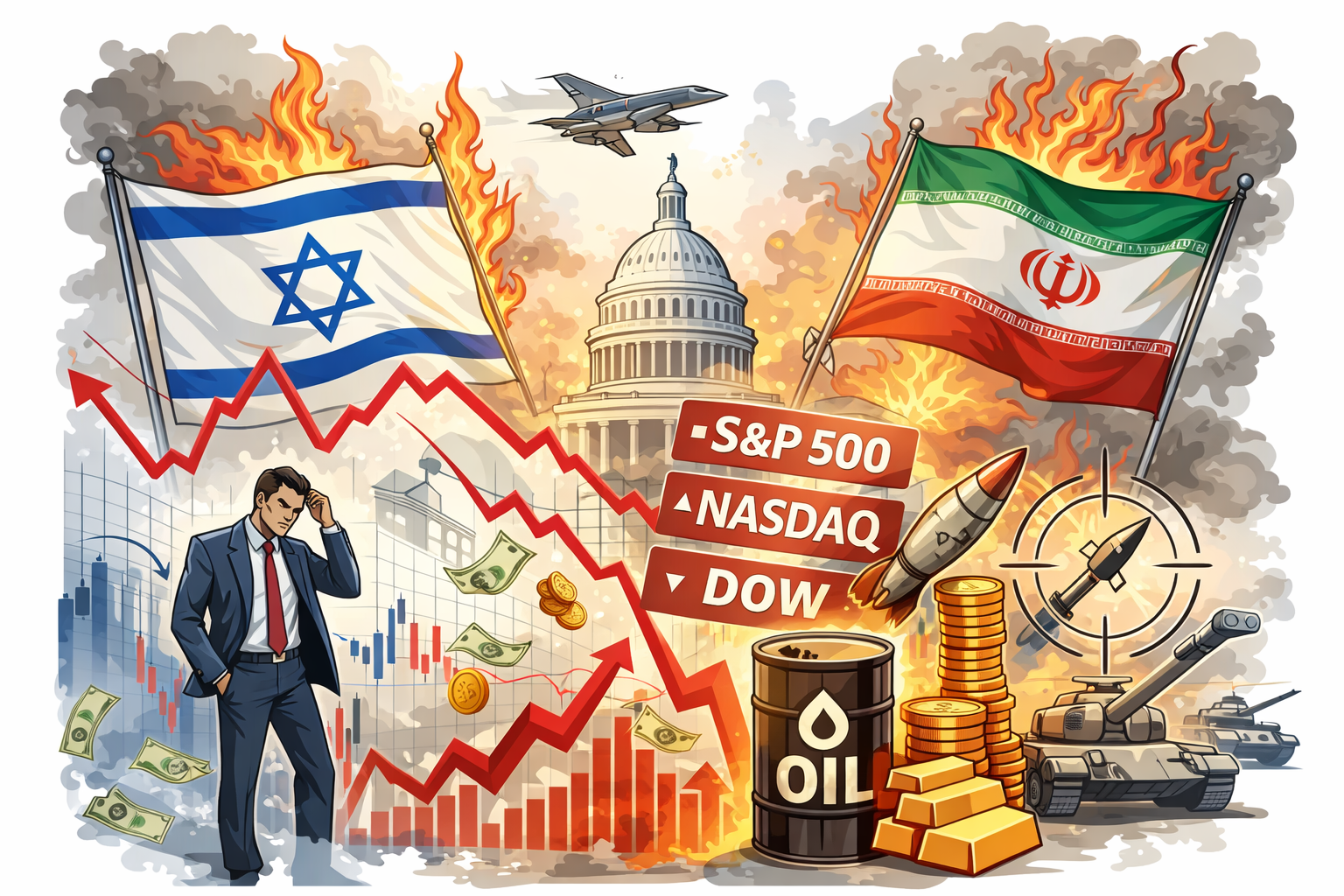
How U.S. Stocks Could React to an Israel–Iran War
Geopolitical shocks have always tested financial markets. An escalation between Israel and Iran would be no exception. While wars are tragic human events first and foremost, investors quickly focus on the economic ripple effects: oil supply, inflation, interest rates, and corporate earnings. Here’s how U.S. stocks are likely to react if tensions intensify into a broader conflict.
1. The Immediate Reaction: Volatility and “Risk-Off” Selling
The first response from Wall Street in any major geopolitical escalation is typically sharp volatility.
Investors tend to:
- Sell broad market indices
- Move capital into safer assets like gold and U.S. Treasury bonds
- Strengthen positions in defensive sectors
The S&P 500 and Nasdaq often open lower in the early days of a conflict as traders price in uncertainty. Volatility indexes usually spike as options activity increases and institutional investors hedge portfolios.
This reaction is driven more by uncertainty than fundamentals. Markets dislike not knowing what comes next.
2. Oil Prices: The Critical Factor
The single biggest variable in an Israel–Iran conflict is oil.
Iran sits near the Strait of Hormuz — a crucial global shipping route for crude oil. Any disruption to supply can cause oil prices to surge. If crude rises sharply and stays elevated:
- Transportation and airline stocks may fall due to rising fuel costs
- Consumer discretionary companies may struggle as inflation pressures households
- Manufacturing and industrial margins could tighten
On the other hand, energy producers and oil exploration companies often benefit from higher prices, which can partially offset broader market weakness.
If oil spikes briefly but stabilizes, the market may recover quickly. If oil remains elevated for months, broader equities could face sustained pressure.
3. Sector Winners and Losers
Geopolitical conflict does not affect all sectors equally.
Potential Beneficiaries
- Energy companies
- Defense contractors
- Cybersecurity firms
- Precious metals producers
Potential Laggards
- Airlines and cruise lines
- Retail and consumer discretionary
- Logistics and global trade companies
- Emerging-market exposed multinationals
Investors often rotate capital rather than exit markets entirely.
4. Inflation and Federal Reserve Policy
A prolonged conflict that pushes energy prices higher could complicate the Federal Reserve’s interest rate outlook.
Higher oil prices feed into:
- Headline inflation
- Transportation and goods costs
- Consumer inflation expectations
If inflation rises again, the Fed may delay rate cuts or maintain tighter policy longer than expected. That scenario can pressure high-growth technology stocks, which are sensitive to interest rate expectations.
However, if the war slows global growth significantly, bond yields could fall as investors seek safety — potentially supporting equities after the initial shock.
5. Historical Perspective: Markets Often Recover
History shows that while wars cause short-term market declines, U.S. stocks often recover once the scope and economic impact become clearer.
In many past conflicts:
- Markets drop sharply in the first days or weeks
- Volatility remains elevated
- Once uncertainty decreases, equities stabilize and resume trend
The key driver is whether the conflict materially damages global economic growth. Limited, contained conflicts tend to produce temporary shocks. Prolonged disruptions to trade and energy supply create deeper market stress.
6. What Investors Should Watch
If tensions escalate, these indicators will matter most:
- Crude oil price levels and stability
- Bond yields (especially the 10-year Treasury)
- Volatility index trends
- Defence and energy sector performance
- Federal Reserve policy signals
These metrics will reveal whether markets view the conflict as temporary turbulence or a structural economic threat.
Bottom Line
In the early stages of an Israel–Iran war, U.S. stocks would likely decline amid uncertainty, with volatility rising sharply. Energy and defence sectors may outperform, while travel and consumer-focused industries could struggle.
Over time, the market’s direction will depend less on headlines and more on tangible economic impact — particularly oil supply, inflation, and global growth.
For long-term investors, history suggests that while geopolitical crises create short-term turbulence, markets eventually adjust. The speed and strength of that adjustment depend on how contained the conflict remains and how deeply it affects the global economy.
Disclaimer: The information provided by Buttonwoodedge Consulting Ltd is intended as general information or an overview and does not consider your personal objectives, circumstances, or needs. Investment decisions are significant and should be made with care. If you are unsure about making a decision based on the analysis or overview presented in our reports, we recommend seeking personalized advice from a licensed adviser. Buttonwoodedge Consulting Ltd disclaims any liability for losses or damages resulting from actions taken based on this information.
RECENT POST
- QNST, BLMN, PGY & HURN:…
- Oil, Inflation and Yields Put…
- All Eyes on Today’s CPI…
- All Eyes on Today’s CPI…
- All Eyes on Today’s CPI…
- All Eyes on Today’s CPI…
- All Eyes on Today’s CPI…
- All Eyes on Today’s CPI…
- Markets Steady Ahead of Fed…
- SpaceX IPO 2026: Expected Valuation,…
- New Record Highs for Markets…
- When Tensions Rise in the…
- Stocks Turn Volatile After Trump…
- Combined Equity Analysis: Pan American…
- Year-End Markets in Focus: A…
- Wall Street Hits Pause: Strong…
- Global Markets at a Crossroads:…
- Stock Market Update: Notable Decliners…
- Earnings Turn Positive: Why Investors…
- This Week’s Top 5 Market…
- Snowflake Inc. Powers Ahead: Strong…
- Nvidia Eyes the Quantum Leap…
- Byrna Technologies Delivers Impressive Q1,…
- Crocs, Inc. (NASDAQ: CROX): A…
- Norwegian Cruise Line Holdings (NCLH):…
- Trump Signs Historic Bill to…
- Markets Respond to Trump's New…
- Magnite Inc. (NASDAQ: MGNI): A…
- Rising Demand for VanEck Defense…
- In-Depth Analysis of Pinterest (NYSE:…
- Marathon Digital Holdings (NASDAQ: MARA)…
- Novo Nordisk (NYSE: NVO) Drives…
- Is Semrush Holdings, Inc. (NYSE:SEMR)…
- Woodside Energy (ASX:WDS) Reports Strong…
- SoFi Technologies Inc (NASDAQ:SOFI): Redefining…
- British American Tobacco (LON:BATS) Reports…
- US Stocks Decline Amid Profit-Taking…
- Upcoming Quarterly Earnings and Growth…
- Outlook for the US stock…
- British Equities Rise Amid Hopes…
- Why Capital Growth is Crucial…
- Global M&A in 2H: A…
- Global stock markets take a…
- General Analysis of Adicet Bio,…
- Copyright © 2026 Buttonwood Edge All Rights Reserved
